Welcome to CW Green Tech Limited

info@cwlyautomation.com
86-136 6712 1125


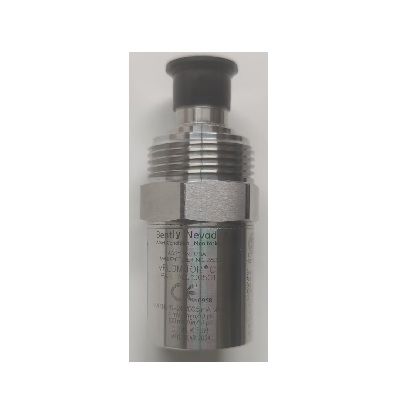
This series is specifically designed for measuring absolute vibration (relative to free space) of bearing housings, casings, or structures. It is a sensor that uses a piezoelectric crystal to sense vibration and outputs a signal proportional to velocity. Its core advantage lies in its solid-state design with no moving parts, which eliminates mechanical wear, allows mounting in any orientation, and provides extremely high reliability.
Model Number Breakdown
The 330500 series sensors follow the model numbering convention 330500-AXX-BXX.
Code Position Option Meaning
AXX (Mounting Thread) 01 1/2-20 UNF Imperial Thread
02 M8 × 1 Metric Thread
BXX (Certification Option) 00 No Hazardous Area Certification
05 Multiple International Certifications (e.g., CSA, ATEX)
Based on the above rules, the specific models you inquired about have the following meanings:
330500-01-00: 1/2-20 UNF thread, no certification.
330500-02-00: M8×1 metric thread, no certification.
330500-02-05: M8×1 metric thread, with hazardous area certification.
Series Technical Specifications
The main technical parameters of this sensor series are as follows:
Parameter Specification
Sensitivity 100 mV/in/s (3.94 mV/mm/s) ±5%
Velocity Range 1270 mm/s (50 in/s) peak
Frequency Response 4.5 Hz to 5 kHz (±3.0 dB)
6.0 Hz to 2.5 kHz (±0.9 dB)
Mounting Resonant Frequency > 12 kHz
Transverse Sensitivity < 5%
Operating Temperature -55°C to +121°C
Housing Material 316L Stainless Steel, Hermetically Sealed
Connector Type 2-pin MIL-C-5015 Hermetic Connector
Weight Approx. 150 grams
Maximum Cable Length 305 meters (no signal attenuation)
Key Features & Applications
Technical Positioning: The 330500 series is a velocity sensor; its output signal directly represents vibration velocity. In contrast, the 330400 series you inquired about earlier is an accelerometer, whose output represents vibration acceleration. The 330500 is more suitable for monitoring the overall vibration energy of machinery.
Core Advantage: The solid-state design makes it extremely rugged and durable. It contains no spring or mass structure found in moving-coil velocity sensors (such as Bently Nevada's 9200, 74712 series), thus eliminating failures due to mechanical wear.
Typical Applications: Widely used for online casing vibration monitoring of rotating machinery such as steam turbines, compressors, fans, motors, and pumps. It is typically used in conjunction with Bently Nevada monitoring systems such as the 3500/42M and 1900/65A.